Pages

Sunday, 8 January 2017

The Womble Project

Orinoco on Wimbledon Common
This is another page I have retrieved from my VT account.

Wombles are small furry creatures that live on Wimbledon Common and pick up litter, making good use of the things that they find, that everyday folks leave behind. They originally appeared in books by Elisabeth Beresford, and later as an animated children's TV series. In the 1970s they even had hit records, and they made a comeback at Glastonbury Festival in 2011.

When young Wombles are old enough to go out on litter duty, they choose a name from the world atlas. Over the past few years, we have been visiting places which provided names for Wombles.
Naturally our Womble-related travels had to begin at the Womble home in Wimbledon Common. We took Orinoco Womble along with us.

Rumba the Macaw
As Orinoco is probably the most famous Womble, our journey proper started in January 2009 with a trip to Venezuela, to visit the Orinoco Delta, after which he was named.I paddled a canoe, went piranha fishing and met a very friendly macaw who helped herself to our lunch and then tried to move in with us.  It was very different from my usual sort of trip, but we also had time for a visit to the historic city of Ciudad Bolivar and a quick tour of Caracas.
Tobermory
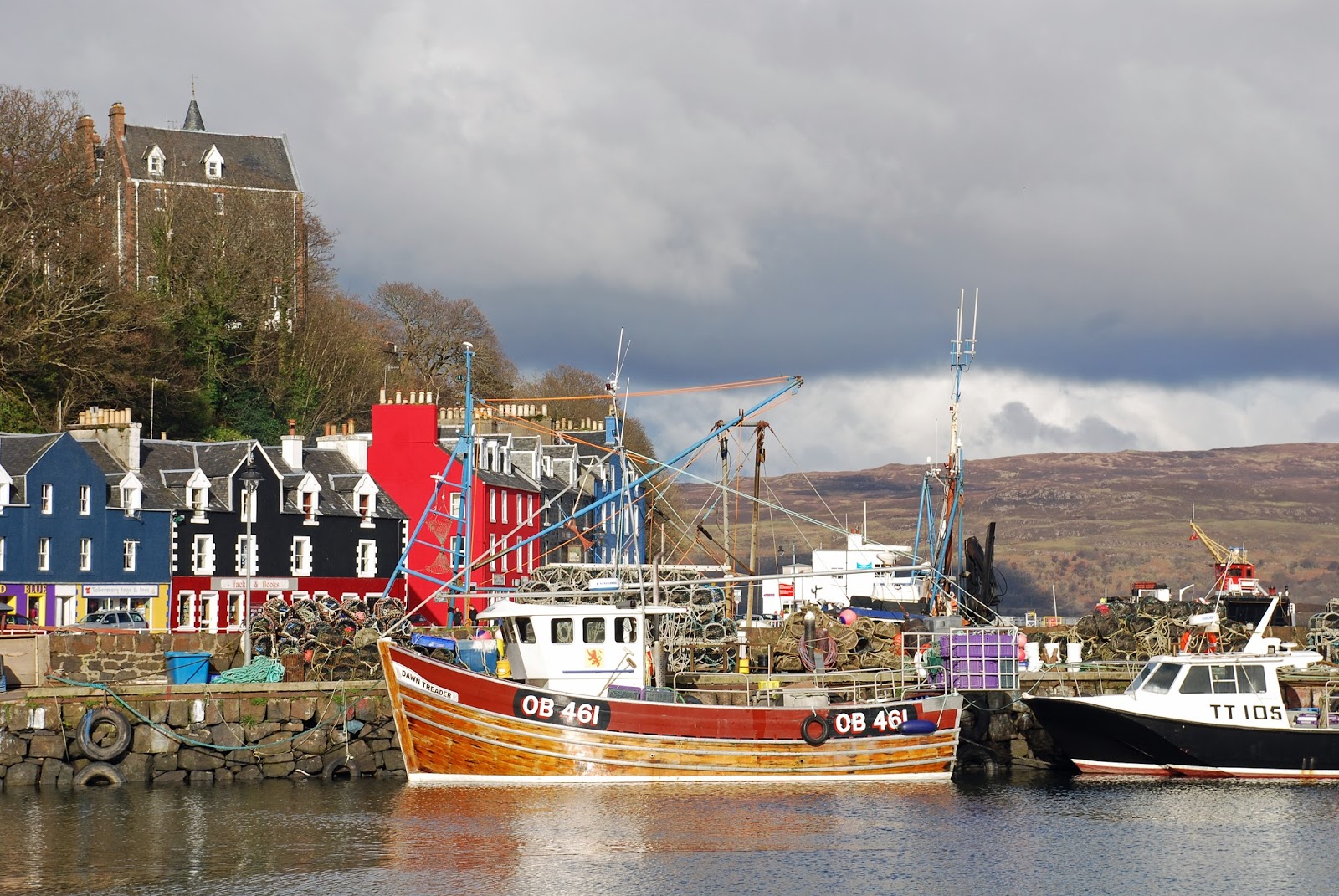
Tobermory was the handyman Womble, who made good use of the things the Wombles found on the Common. But Tobermory the town on the Isle of Mull is rather more well known for the children's TV series, Balamory, which was filmed there.

Great Uncle Bulgaria in Bulgaria
Great Uncle Bulgaria is the senior Womble in the burrow. Bulgaria was the only place on our Womble itinerary that we had visited before, so we decided to do something different, and opted for a walking holiday. I imagined it would be like the guided botanical walks I had done in Crete. This was a bit of a miscalculation. I realised that shortly after arriving when the group leader asked if our insurance included helicopter evacuation...


Tomsk
Tomsk is the sporty, brawny Womble. But Tomsk in Siberia is a city with a number of universities ('the Oxford of Siberia'?). Our visit gave us an excuse
to travel on the Trans-Siberian railway. This provided us with an extra 'bonus' Womble, as the train also passed through Omsk, the name of a visiting Russian Womble in one of the books.

Cholet
Cholet is a small French town that we would probably never have visited if it had not been for the Womble project. As Mme Cholet was the Womble chef, we went to the 'Festival of Rural Deliciousness' -mmm apple fritters!


Wellington was the brainy Womble. Sadly, we didn't make it to New Zealand (yet!). Fortunately, there are a pair of Wellingtons in the UK: one in Somerset and one in Shropshire. The Shropshire one is near the Wrekin, where we took our pocket-sized Wellington for a walk. For Womble purists, it's the Somerset one that Wellington Womble is actually named after.

Bungo and his bridge
Last, but not least.... Bungo!  Bungo was a self-important, bossy Womble. He picked his name by closing his eyes and pointing at the atlas. Bungo actually turned out to be an old name for an area in southern Japan. When we got there we were excited to find that Bungo had his very own bridge in Kitakyushu. We only found it thanks to the time-travelling racoons, but that's another story...


Our final trip of the project was to Adelaide. Miss Adelaide looked after the Womble nursery. She is mentioned in the books, but didn't appear in the original TV series. In Adelaide we met another small furry creature beginning with 'Wom...' - a wombat!
A wombat in Adelaide Zoo


The Gotham of the Desert

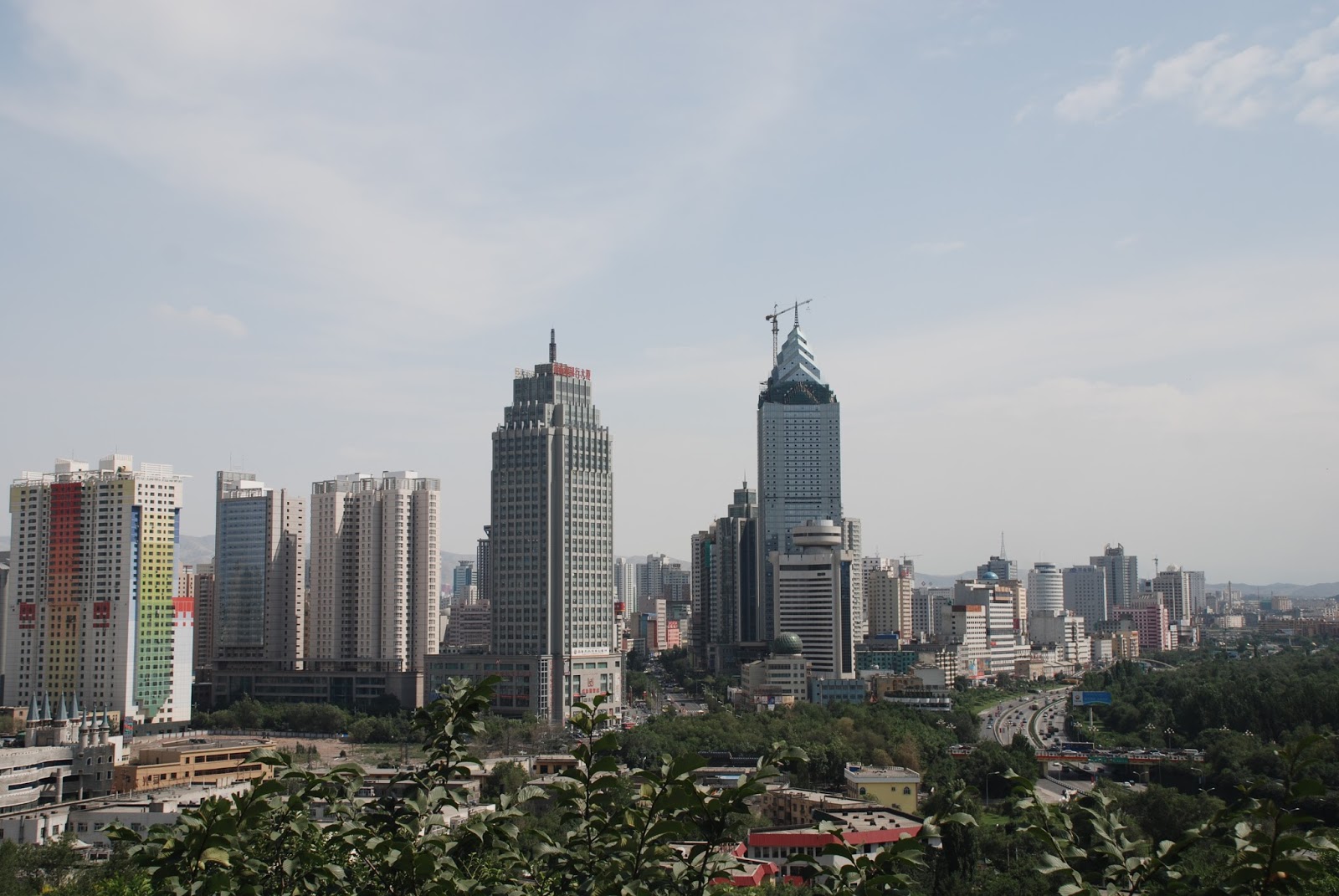
Photo of Urumqi
Urumqi
This is a travelogue concerning part of our Central Asian trip in 2007 that I have retrieved from my Virtual Tourist account.


Buying grapes in Turpan
The day started with a three hour drive from Turpan to Urumqi. The driver appeared to go the wrong way at first, but Tony (our local guide) said he wanted to buy some local Turpan grapes. He then presented us with a big box of them as a present! The drive to Urumqi was very scenic – bare mountain and desert, following by a river valley.

After two hours we came to a large wind farm, where we stopped
Wind farm
to take photographs and I encountered my first really disgusting pit toilet – even the flies recoiled. Later we passed a salt lake (which allegedly had similar properties to the Dead Sea) then a freshwater lake and a reservoir.

Urumqi, the capital of Xinjiang province, is a very modern city, which has only been built in the last fifty or so years and looks a bit like a sort of Gotham City in the middle of the desert. Our first port of call was the museum, which is best known for the mummies found in the desert. We were first shown an exhibit of the different peoples of Xinjiang (Uighur, Kazakh, Mongol, Manchu etc.), before being taken upstairs to see the famous mummies with European features, including the Loulan beauty; a woman who was buried with a small mask containing human teeth; a four year old child; and a couple from 1800 BC (she of mixed European and Mongol ethnicity, he of European) – the textiles they were wearing were finely woven and very well preserved. The way out of this exhibition passed through the inevitable gift shop, which included reproductions (and allegedly genuine antiquities) as well as very beautiful, but heavy, books about the discoveries.

Tony then took us to lunch. We told him that we were not too hungry, so he only ordered beef with vegetables; chicken with peppers and mushrooms (very bony, but the mushrooms were good), Chinese leaves; cabbage with prawns (slightly worrying in the city that is distinguished for being furthest from the ocean) and soup with tofu and leaves. Goodness knows how much food we would have been offered if we had said we were hungry!

Bazaar in Urumqi
After lunch we went to the bazaar. There were lots of raisins from Turpan, dried apricots and spices, but overall it was more like a modern shopping mall than a traditional eastern bazaar.

Tony then asked what we would like to do next, as we had time to kill before our flight to Kashgar. Having been in China for a while by this point, I now knew the ropes so I vetoed his suggestion of a visit to a carpet factory, and suggested the park which he had pointed out to us as we drove into the city. I think he thought we were mad. He said he hadn’t been there since he was ten years old, but he complied with good grace. The park turned out to be attractive, with flowers, amusements for children, stands celebrating every modern Olympic games, refreshment stands but toilets that were only marginally better than those near the wind farm.

Red Hill Park, Urumqi
We had a cold drink on a terrace with a great view of the city, where a PA system was (bizarrely) playing Una Paloma Blanca and then visited a pagoda which also had a good view of the city, and another smaller pagoda which marks the spot where the head of a serpent is trapped. The serpent’s tail is trapped by a pagoda on an opposite hill – if the buildings collapse, the serpent will be freed and Urumqi will be destroyed by flood - (allegedly).


After that, Tony got his revenge saying that as there was still some time to kill before our flight to Kashgar, we could visit the government gift shop.   

Saturday, 7 January 2017

End of an Era

7 January 2017

I have written here previously about my involvement with Virtual Tourist.

Yesterday I received the following email:
We have made the difficult decision to close down VirtualTourist.com. On Feb 27th 2017 the site will be wrapping up operations. We wanted to let you know this now so that you have a chance to save any personal content and obtain contact details for other members you’d like to stay in touch with. After the closure all user data will be deleted.
Over the last 18 years, 1.3M members have shared 3.7M photos and posted 1.8M travel tips on 73k destinations! Your contributions to our online community are very much appreciated and we hope you enjoyed the journey as much as we have! We hope that the friendships you have made through VT continue on for many more years to come.
You’ll still be able to find all the great destination information we’ve amassed over the years plus much, much more atwww.SmarterTravel.com. And to continue the conversations from our forums we recommend www.tripadvisor.com/ForumHome.
Thank you for being a valued member of the VirtualTourist community.
Safe travels,
The VT team
I can't say that it was a total surprise, as usage has been declining, but a huge amount of effort has been made over the past year or two by staff and members to move the content onto a new code base so that it is up to date with modern web standards. The staff, who have always been really good about responding to members' queries and letting us know what was going on, were simply laid off with no warning.

Virtual Tourist was a place where members could write their own pages, itineraries and travelogues, as well as the tips or reviews of specific attractions, hotels, restaurants that are so dear to Trip Advisor. There was also an excellent travel advice forum, and a social side with a 'Miscellaneous' online forum and real world VT meets.

When I think about the amount of time I have spent building tips and pages, and doing site admin, I could weep.  I'm now busy trying to retrieve what I can from the shipwreck, and will post some of it here.

Sunday, 25 December 2016

A Hairy Time in Barcelona?

The Plaça Catalunya is the terminus of the airport bus and the arrival point of many visitors to Barcelona. From here it is possible to stroll down the series of avenues known as Las Ramblas to the Columbus monument and the sea.  If, that is, you do not get distracted by the bird market, the flower market, the artists or the living statues along the way, as we did.   There was quite an epidemic of living statues in the city, from grey, traditional statues, to clowns, robots, mummies and a green painted pixie (or alien). There have to be better ways to earn a living than painting yourself white and standing still all day, but it must be quite lucrative for so many of them to do it.  In addition to the living sculptures, Barcelona is also adorned by modern sculptures; the result of a public sculpture programme intended to brighten up the city for the 1992 Olympics.
Wilfred the Hairy

Our first port of call in a city famed for its art and architecture was, naturally, the zoo. Barcelona zoo is famous for its albino gorilla, known as Snowflake, but we were more interested in the pair of rare hyacinth macaws.  For those who are concerned about the morality of zoos, I can only observe that Barcelona zoo appears to be well run, and to have conservation, rather than spectacle, as its main priority. 

Having visited the zoo, we turned to the artistic delights of Barcelona.  The Museu Picasso is one of those museums that guidebooks tell you is worth visiting, even if you are not interested in the art, simply for the building alone. There is a certain justification for this, for the museum is situated in two fifteenth-century palaces in Barcelona’s Gothic quarter.  Unsurprisingly, since the artist lived in Barcelona between the ages of 14 and 23, the collection is strongest on his early years.  However, for me the most interesting part was the series of paintings based on interpretations of Velázquez’s Las Meninas, which become increasingly abstract, so that it becomes quite difficult to spot the dog, let alone the children. 

Before coming to Barcelona I had heard a lot about La Sagrada Familia, the huge unfinished church designed by Gaudí.  This is not to be confused with the Cathedral, in the old town, which is gothic, dating mostly from the thirteenth and fourteenth  centuries.  Its principal curiosity is the gaggle of geese that live quite happily in its cloister.  The Cathedral is also noteworthy for the carving of Wilfred the Hairy on one of its portals.

Wilfred the Hairy (Guifré el Pelós) was a character who unified Catalonia in the Dark Ages, a sort of Catalan Alfred the Great.  He was Count of Barcelona in the ninth century, and was fittingly a contemporary, and nominally a subject, of the Carolingian emperor Charles the Bald.  Disappointingly, some historians now question whether or not he actually was hairy, or whether his soubriquet became misinterpreted over time (rather like the argument about whether Ethelred was unready or not).  Unfortunately, there are few traces of the hirsute one to be found in modern Barcelona and his tomb is in the church of Santa Maria del Ripoll in the north of Catalonia.  A suitably hairy portrayal of Wilfred can be seen on one of the portals of the Cathedral, killing a dragon.  Unlike St George, who also adorns the portal, Wilfred needs no armour to protect him.

In the square outside the cathedral we saw a procession of schoolchildren in fancy dress and yet more living statues.  I felt rather sorry for the Egyptian mummy. He was supposed to be fully encased in gold lycra, but he had trouble doing it up properly at the back, so that there was a clear view of his vest and shorts. I really wanted to go and tuck him in, but fortunately managed to resist the temptation. 

The day after visiting the cathedral, we visited some of the famous buildings designed by Gaudí, starting with the Park Guëll.  This was not designed to be a park, but an upmarket housing development, for which Gaudí was commissioned to provide the infrastructure, which included entrance lodges, a marketplace and square, and a mosaic lizard fountain.  In the event, only two of the building plots were developed, and the site became a park. One of the houses is now a Gaudí  museum. On Saturday and Sundays between 10.00 a.m. and 2.00 p.m. there is an ‘art exhibition’ or gathering of artists displaying their wares. For those like us who collect pictures as souvenirs of our travels, this could prove costly.  It is also not entirely practical to purchase a large watercolour painting on a somewhat rainy day.

Casa Milà, also known as La Pedrera (the stone quarry), is an apartment building, with a distinctive, curvy, organic-looking façade.  It is possible to go in and see one of the apartments furnished in the contemporary style and to go up to the roof terrace to have a close up view of the weirdly shaped chimney pots. The final Gaudí site we visited was the (in)famous Sagrada Familia.   This was unfinished at the time of Gaudí’s death, although work is now taking place to complete it. Our first view was of the newer façade, depicting the Passion, which looked fairly normal.  Having passed through the building, we came upon Gaudí’s original façade, depicting the Nativity.  This, according to my husband, resembled ‘the gaping maw of hell’, though I am not sure how he was able to recognise it.  It is certainly unusual.  The decoration is very organic and flowing in appearance. As well as the figures of the Holy family, there are all sorts of creatures, even a turkey, and at the top there is something which looked to me like a Christmas tree with doves on it.

The Park Guëll, with its strange buildings and vistas, had reminded me slightly of Portmeirion. The following day we visited the Poble Espanyol – an artificial ‘village’ created for the Universal Exhibition of 1929, containing examples of architecture from each region of Spain.  This was even more like Portmeirion. Now the buildings house souvenir shops, exhibitions and cafes, including an exhibition of fans, with an alarming commentary:  “Foamy specimen and of manual prestige, the fate, whatever ends be in its use in feminine presdigitation, still conserves its suprahistorical charm of fascinating manufacture…”.  The central square is often used for performances and concerts.  We left hurriedly as a country and western group started to perform. 

The Poble Espanyol is on the Montjuïc hill, and it is a relatively short walk from here to the Olympic area.  Here we saw the stadium, already looking rather sad and neglected, and the very space-age looking Palau d’Esports Sant Jordi.  Further down the road was the Fundació Miró, founded by the artist Joan Miró,  as a centre for study and experimentation in contemporary art.  Although I am a bit sceptical about some modern art, especially of the unmade bed variety, I found this interesting, particularly the mercury fountain.  My husband, who is even more sceptical than I, declared that one or two of the exhibits were ‘a load of old nonsense’ but even he was fascinated by the brightly-coloured sculptures on the terrace, which were figures made from unusual objects.

To return from Montjuïc to the city centre there is a choice of funicular or a cable car, which takes you down to the harbour. The cable car delivered us to the vicinity of the harbour fish restaurants just in time for a leisurely Sunday lunch of suqets de pescadoi (fish stew) followed by a caramel fruit dessert. 

There is a huge choice of food in Barcelona: Seafood paella, chicken paella, mixed seafood and chicken paella, vegetarian paella and black paella made with squid ink are widely available.  In addition, there are a huge range of tapas, and local specialities, such as the aforementioned suqets de pescadoi and bullabesa,  a fish soup.  The most ubiquitous dessert is crema catalana, a type of crème brulée, closely followed by what was described as ‘heavenly pudding’, a sort of sweet terrine, with a caramel topping.  The fruit version of this is particularly delicious. 

Getting around Barcelona is easy. There is a comprehensive metro system as well as the local buses, and the city is relatively compact so that many of the things to see are within walking distance of each other and the hotels.


I would thoroughly recommend Barcelona for a short break, but one word of warning: it seems to be an extremely popular venue for student visits. All of the colleges in my area seemed to be having field trips there at the same time as our visit.  

A Taste of Sorrento

The writers of nauseating management platitudes say that when life gives you lemons, you should make lemonade. In Sorrento, they appear to have taken this advice to heart in a big way. There are a lot of lemons in Sorrento. The town is surrounded by lemon groves, their trees carefully protected with netting against giant hailstones.  But they don’t only make lemonade. They make all sorts of lemon-flavoured products: limoncello, a liqueur which can only be described as a cross between lemsip and paintstripper; lemon ice-cream; lemon sorbet; lemon granita; lemon sweets; lemon biscuits; lemon chocolate; lemon sauce; lemon risotto; lemon profiteroles. You name it, they do a lemon version of it.  If the edible versions were not enough, they also do lemon soap and numerous tourist souvenirs of varying degrees of merit featuring lemons, ranging from ceramics and table linen to fridge magnets.  It would be quite easy, if pointless, to have an entirely lemon-flavoured meal, served on tableware decorated with lemons.

I am not that keen on lemons as such, but I tried several of the lemon-flavoured edibles in the interests of research.  Lemon risotto is quite pleasant, if a little too like rice pudding for a starter. Pasta with lemon sauce is more interesting, particularly when made with unusual star-shaped pasta.  ‘Lemon delicious’ is a sponge-based dessert with lemon cream, which is surprisingly pleasant, and nothing at all like the synthetic lemon-flavoured desserts I remember from school dinners.  I would add though, that a chocolate version of this dessert looks more delicious still. Lemon granita (a refreshing crushed ice concoction) is widely available from Sorrento’s gelaterias and from street stalls in Naples, and very welcome in the heat, but overall the quality of granitas in the area does not match that of Sicily, where they are a little more sorbet-like.

Sorrento’s gelaterias serve ice cream and sorbets in many other flavours as well as lemon, from the anagrammatic melon to apple, and from amaretto to tiramisu. The oddest flavour I saw was Ferrero Rocher  - presumably the Ambassador comes to Sorrento for his holidays. One gelateria has a menu for ice-cream sundaes that is as thick as a telephone directory.  The bigger gelaterias also serve a waistline-threatening range of cakes.  Interesting patisserie is also available in cafes and bakeries.    

Pizza was of course invented in the Naples area, and it is impossible to beat a genuine Italian pizza made in a proper pizza oven. Whilst purists might argue that real pizza should be topped with nothing more than tomatoes, mozzarella and a sprinkling of herbs, pizzerias offer versions topped with other items including ham, sausage, mushrooms and artichokes. Those looking for a Hawaiian pizza with pineapple will however be disappointed.

Pasta is also good.  Seafood versions, such as spaghetti alla vongole are delicious. For the more adventurous, I can recommend ravioli with almonds and cherry tomato sauce.  This is in effect marzipan ravioli in tomato sauce, garnished with a langoustine. It may sound revolting, but actually tastes surprisingly good.  The Sicilian speciality of pasta with tomato and aubergine sauce is also widely available, although here it goes under the name of ‘Siciliana’ rather than ‘alla Norma’.

After such interesting pasta starters, main courses can seem a little dull, but a plate of mixed fish and seafood from the grill is never boring.  The only problem is finding room for the dessert afterwards.

If you are planning to visit the Sorrento area, be prepared to gain a few extra pounds.


Friday, 7 October 2016

The fat, the red and the ugly

Those nice people at Optima magazine have published an article by my other half about our trip to Bologna this summer.  You can read it here.

I would thoroughly recommend Bologna as a base for exploring Emilia Romagna.  It's very attractive, with historic buildings and squares, has superb food and excellent rail links.


Saturday, 17 September 2016

Mosaics and Mausoleums


"to Charles Ryder, with the aid of whose all-seeing eyes I first saw the Mausoleum of Galla Placida and San Vitale..." (Evelyn Waugh, Brideshead Revisited)

San Vitale
I had wanted to visit Ravenna ever since reading these words in Brideshead Revisited.
The brief mention of Charles Ryder's 'economical' Easter vacation in Ravenna with his friend Collins, who considered the mosaics to be inferior to their photographs has stuck in my mind ever since I first read this book whilst at school. Spending a week in Bologna, an easy train ride away, finally gave me the opportunity.

On arrival, we went first to St Apollinare Nuovo, and purchased a ticket that gives admission to five of the UNESCO World Heritage sites for €9.50.  The church was built in the late 5th or early 6th century on the order of Theoderic, and was originally intended for Arian worship.  After 540, when the city was occupied by the Byzantines, all the Arian buildings were taken over by Catholics, and the church was rededicated to St Martin of Tours. The current name originates in the mid-ninth century, when the relics of St Apollinare, the first bishop of Ravenna, were ostensibly moved there from the basilica of St Apollinare in Classe. It was called St Apollinare Nuovo to distinguish it from a smaller, older church in the city also dedicated to St Apollinare.

In front of the original façade is a marble portico dating from the 16th century.  There is also a cylindrical bell tower some 38 metres high which dates from the ninth or tenth century.
The baroque apse and 17th century ceiling are beautiful, but it is the mosaics which visitors really come to see. Even though I was expecting them, the mosaics were stunning. Legend has it that Gregory the Great (the pope who sent missionaries to England) ordered them to be blackened and covered up as they were too distracting for those at prayer.

Next we visited Battisterio Ariano. This was built in the late fifth century as the baptistery of the Arian Cathedral, at a time when Arianism, a heretical doctrine which disputed the divinity of Christ and thus disagreed with the view of the Trinity as God in three persons, was the official court religion. The baptistery was re-consecrated in the Orthodox tradition in 561.  The only surviving mosaic decoration in the interior is in the dome, which shows the baptism of Christ. The design is a similar to that in the Neonian Baptistery, which clearly provided the inspiration, but is much simpler.

After passing through the Piazza Populo, we visited the Basilica St Vitale. This basilica was founded by Bishop Ecclesio following a journey to Constantinople with Pope John I in 525. It was consecrated in April 548.  Unlike St Apollinare Nuovo, it does not have the traditional three naves, but is octagonal in shape with a central core beneath a dome.

The mosaics cover the walls and vault of the presbytery and the conch of the apse and. In the apse is a mosaic showing Christ presenting a crown to St Vitale with his right hand.  To the other side is Bishop Ecclesio, carrying a model of the church.  Below these are beautiful mosaic portraits of the Empress Theodora and the Emperor Justinian. The arch surrounding the apse is decorated with a motif of cornucopias, birds and flowers.

Nearby is the Mausoleum of Galla Placidia, the daughter of Theodosius I. Built in the second quarter of the fifth century it is one of the oldest monuments of its kind, and its mosaics are the oldest in Ravenna.

The mosaics are rather different from the others, as the artistic style is Roman rather than Byzantine.  I was particularly struck by the midnight blue of the sky and the depictions of pairs of deer.

Galla Placida had a very interesting life. She married twice, firstly to a barbarian called Ataulf, and later to Constantius III, with whom she had two children, Honoria and Valentinian. She ruled Ravenna for many years, as empress, and later as regent for her son Valentinian. Despite the name, her remains were never housed in this mausoleum. She died in Rome and is buried in the Theodosian mausoleum there.

Neonian Baptistery
The Neonian Baptistery, our fifth port of call,  is the oldest of Ravenna’s surviving ancient buildings, having been begun in the  late fourth or early fifth century. The mosaics, however, are as not as old as those in the Mausoleum of Galla Placida, as they were not added until the mid-fifth century at the behest of Bishop Neone.

The design of the mosaics in the centre of the dome is similar to that of the Arian Baptistery, which it inspired, with Christ depicted at waist-depth in the river Jordan, being baptised by John the Baptist, clad in a goatskin. But the saints in the decorative band surrounding this medallion are not portrayed with haloes. Below this, are alternating decorations of empty thrones and thrones with crosses or altars.

The last stop on our tour of mosaics was the Archiepiscopal Museum, housed in the bishop’s palace.. One of the highlights of the collection is the sixth century ivory throne of Bishop Maximian, and a marble calendar showing the dates of Easter for the years 532 go 632 AD.  The building also includes the chapel of San Andrea, the private chapel of the Bishops, with more mosaics of the Apostles and other saints and a warrior Christ.
After a stop for a lunch of salami piadine we set off in search of Dante’s tomb.

Dante Alighieri died in Ravenna on the night of 13/14 September 1321 whilst in exile from Florence and was originally buried under a small portico in the church of San Francesco. In 1519, Pope Leo X authorised the transfer of the poet’s remains to Florence, but when the Florentines arrived to collect them they found the tomb empty as the monks had broken in and removed the body already.  They kept it hidden for centuries and the remains were only finally placed in the original sacorphagus after they were rediscovered during excavations in 1865.

The current tomb building was erected in 1780 at the request of Cardinal Legate Luigi Valenti Gonzaga, whose coat of arms can be seen above the entrance.   A lamp hanging from the ceiling burns olive oil from Tuscany which is provided by the city of Florence. But that was not the end of Dante’s travels. In a nearby courtyard is an ivy-covered mound which marks the place where his remains were buried for safekeeping during the second world war.

Our final visit was to the Duomo.  The first cathedral on the site was built in the early fifth century, but all that remains of that are a few fragments in the museum.   The old cathedral, after many additions and alterations over the years, was demolished in 1733, and the current building was completed in 1743.  The bell tower, however, dates from the tenth century.

Inside the cathedral the effect of crimson brocade hangings on yellow ochre walls resembles a regency-striped drawing room.  Until, that is, you look in the Chapel of the Beata Vergine del Sudore, a very elaborate baroque chapel, also containing two late fifth century sarcophagai.

On our walk back to the station, we saw the ‘Palazzo di Teodorico’, the façade of a 6th or 7th century brick building.  The original function of the building has not yet been established. We also passed the church of S Maria in Porto, where sculptures from the modern art gallery next door struck an incongruous note.  


We had time for tea in the nearby park before catching our train back to Bologna.